C. elegans Genetic Nomenclature Basics
Last modified: 17 August 2026
Nomenclature must be followed precisely to avoid any confusion about strains. The primary description of C. elegans nomenclature conventions can be found in
"A uniform genetic nomenclature for the nematode C. elegans" by Horvitz H, Brenner S, Hodgkin J, Herman R (1979), Molecular & General Genetics 175: 129-133.
Pubmed
This information plus additional recommendations can also be found at Wormbase -
UserGuide:Nomenclature
The two main components of worm nomenclature are a strain number/designation and a genotype. These are explained further below with examples.
Example 1: Single mutant allele in a strain
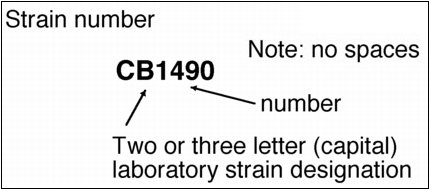
The two or three letter lab designation indicates where the strain was originally isolated or constructed. Some examples of lab strain designations include:
CB - Cambridge ("The MRC LMB" - where Sydney Brenner and colleagues began it all)
MT - Horvitz lab (MIT)
BC - Baillie lab (Simon Fraser University, British Columbia)
The Loer lab designation is LC.
A complete list of lab designations ordered by strain designation found at the
Caenorhabditis Genetics Center.
Also, Lab designations ordered by Principal Investigator / Lab Head last name
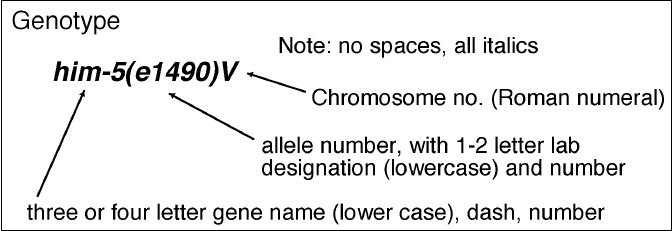
This is a complete description of all the mutations in the strain. In this example, the strain contains a single mutant allele.
This particular strain could also be described by the allele number: e1490. This is a unique identifier - no other gene will have an
"e1490" allele. Using the allele number alone, however, would not indicate the genetic background of the strain. The strain CB1490 has
been outcrossed to remove background mutations found in the original isolate after mutagenesis (which would superficially appear to have the
same genotype.) Therefore, the strain number is always the best and safest way to label your worms. The strain number is also a unique identifier that
indicates the genotype and background (construction / isolation / outcrossing history) of the worm.
Some common lab allele designations include:
e - Cambridge ("england")
n - Horvitz lab
s - Baillie lab
The Loer lab allele designation is pa.
A complete list of lab designations ordered by allele designation.
[Note that the alphabetical list begins with about 80 labs that lack an allele designation, so there's a bit of scrolling down to reach
the first allele designations 'a, aa, aaa, aab...' ]
How to find out what that three-letter or four-letter abbreviation means? Search the abbreviation on WormBase, selecting 'Gene Class'
on the pulldown menu.
Although gene names were originally restricted to three letters, this has been increased to four letters to accomodate the need for more gene names.
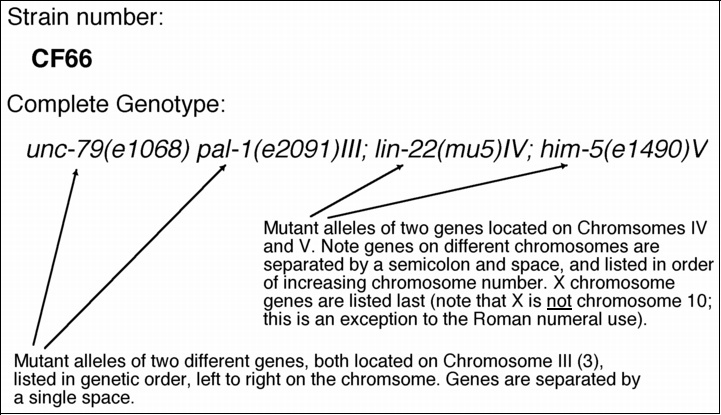
Example 2: Four mutant alleles in strain CF66, two on the same chromosome
Some other genetic nomenclature:
Df - Deficiency (part of a chromosome is missing)
Dp - Duplication (part of a chromsome is duplicated)
C - Crossover-suppressing rearrangement
Ex - indicates DNA in a transgenic organism, maintained extrachromosomally
Is - indicates DNA in a transgenic organism, integrated into a chromosome
Back to the Loer Lab Protocols Page