This page is meant to give you an overview of many techniques, etc. that we use in our lab. Some information has been linked to webpages that have already done a good job of explaining things (why remake what is already done well). I strongly encourage you to peruse this page often to ensure you are well-prepared for the research tasks you will be performing. However, please note that this page is not the "Be-all and End-all" of information and the information presented does not replace the hands-on training provided by the University, Department, and Dr. Daley. You must (i.e. are required) undergo the University's official training before you perform any research tasks. Even with proper training, accidents can happen and thus it is also imperative that you are well-versed with your Safety Training. Safety links have been added on this page but again, they are not a replacement/substitute for the Univeristy's official training, which you are reqiured to repeat each semester to stay current on the practices recommend.
If at any time you notice an error on this page or if you have any questions, please contact Dr. Daley.
The Safety in the lab is imperative. There are no exceptions. Please note that it is a privilage to work in a research group and not a right. If a student does not follow the proper safety protocols, they will be removed from lab immediately. Having said that, you are also working with other group members and thus it is important that everyone communicates with each other to ensure everyone is aware of the reactions/practises that are being performed in the lab at any time. This means: proper labels on reaction flasks; up-to-date notebooks; proper storage of waste (including waste labels); proper storage, organization, and cleanlyness of labware; and signs, warnings or other, to indicate potential hazards as necessary.
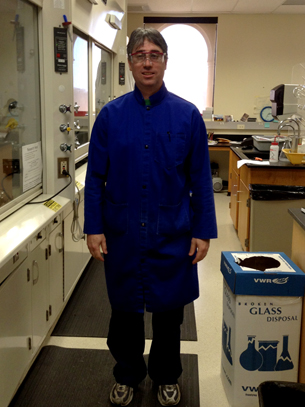
Proper Lab Attire:
Everyone is required to wear, at the minimum (pictured): (a) an appropriate lab coat (blue coats for use of pyrophoric reactions/reagents), (b) safety goggles, (c) closed-toe, durable, non-slip footwear (i.e. not thin canvas shoes), (d) appropriate clothing (bare legs should not be exposed - use scrubs if needed). If you have long hair, you are also required to have it tied back. Outside of these minimum requirements, you must also wear protective gloves - we generally use disposable nitrile gloves for most operations, even reagents that may be deemed ok to handle without them. If you use the glovebox you must wear cotton gloves over nitrile safety gloves for adequate protection as well as ease of movement when using the glovebox arm-gloves. A dust mask must be warn when appropriate (e.g. handeling silica gel).
Lab Environment:
This is a group environment - be respectful of everyone: (a) music is allowed to be played in lab as long as (i) it is not too loud for you to hear people talking with their voices at a resonable level (i.e. you can hear if someone needs help!), (ii) the music is acceptable to those in lab (note: explicit language or other offensive songs are not permitted at any time - keep the environment professional!), (iii) it is played from a laptop, iPod, or similar device that is broadcast throughout the lab (you can never wear personal ear-buds to listen to music as it is a safety hazard - you cannot hear things around you!). (b) Keep the lab clean! Do not let glassware pile up, sample vials collect in hoods, labware remain out when not in use, etc. Also, keep the student sitting and computer areas clean and organized. (c) If you are the last to leave make sure you follow the lab check-list located on the main lab door (i.e. ensure no valves are left unintentionally open, solvents are put away, waste is disposed of, etc. (e) Keep an eye on the lab inventory: (i) if a reagent is getting low inform Dr. Daley so we can get more before we run out, (ii) if washing reagents are running low (e.g. saturated NaCl(aq)) be a good citizen and make more, (iii) if labware breaks or is not functioning let Dr. Daley know immediately. If Dr. Daley finds it on his own, the level at which, and the length of time, he will be upset will be considerable whereas if he is infomred immediately his angst will most likely only last for a few minutes (i.e. he will be very appreciative of informed in a timely manner and he will not be too upset unless someone was careless). (e) If at any time you have a question or concern, please comminicate it to Dr. Daley.
Performing Reactions, Workups, Etc.:
Performing research tasks: make sure you have diagramed out the procedure and accounted for all labware needs beforehand. This means (i) having prepared your reaction table in your lab notebook; (ii) checking to see that sufficient supplies of chemicals, etc. are available; (iii) having labware prepared (e.g. glassware is dried overnight as necessary); (iv) Rule: You started it - you must finish it! ensuring you have accounted for the time it will take to do the task (you cannot leave a task until it is completed or left at a place where it is deemed fine to remain for an extended period. You can only make the latter call in concert with Dr. Daley!); (v) having made note of all potential safety issues. This includes knowing all the properties of the chemicals you will use (MSDS sheets), an appropriate lab coat (blue coats for use of pyrophoric reactions/reagents); (vi) ensuring someone will be present when you perform the task. There are only a very limited set of procedures (consult Dr. Daley before attempting any) that can be performed without anyone else present in the immediate labspace but someone must still be in the vicinity, informed that you are working and for approximately how long so they can check on you.
I have collected a listing of methods (below) for your use. Some of these will connect you to other websites, others will contain short video tutorials, etc. Please visit this page to refresh your knowledge on how to perfrom research tasks before you attempt them. If you find some methods inadequately described, in error, or if some are not present that ou would like to see, please communicate it to Dr. Daley so that it can be properly addressed..
General Cleaning Tasks:
Non-precision Glassware: must be cleaned by first degreaseing and greased joints by using a wash-pentane bath and pipe-cleaners/Kimwipes. Once degreased, glassware must be thoroughly scrubbed clean with soap and warm water. The cleaned glassware is then rinsed with DI water followed by a small amount of acetone for the inner part of glassware and finally the outsides are dried with paper towels and the flasks are placed on the peg board (or if the rack is full or you have fragile glassware - on a benchtop with paper towels under them).
Note: Glassware must be cleaned within 24 h of end of reaction except for the glassware containing your final product, which can be left for 48 h before the product must be transfered to a pre-weighed, labeled, vial either in the glovebox (if air and or water sensitive) or in the fumehood (if not air an/or water sensitive).
Syringes, needles, cannulae, etc.: must be cleaned immediately after they are used! We clean them using the 4 solvent method (click link for video demonstration). Hook up a vacuum filter flask to the ouse vacuum line and place a septum over the mouth of the flask. Using very slight vacuum, insert the labware (e.g. needle, cannula) into the septum and the use a wash bottle (for syringes and sometimes needles) to inject the wash-solvents through the labware in the order: 1. acetone; 2. methylene chloride; 3. DI water; 4. ethanol (95%). As a rule of thumb, give three small squirts for each solvent - only use more if necessary. Alternatively, for long needles and cannulae, you can simply dip the end that is not in the septum into beakers containing the wash-solvents in the same manner as above (again 3 quick dips per solvent). If you encounter a clogged needle, cannula, syringe, etc. please contact Dr. Daley immediately.
Note: Syringes, needles, cannulae must be cleaned immedaitely after use. At minimum they must be rinsed with acetone until clean and not-clogged. They can then be cleaned using the 4 solvent method within 24 h. Once cleaned, the cannulae and needle (stainless-steel ones) go into the oven for storage. Glass syringes are stored back in their appropriate spot with the plunger removed and set beside them.
Balances: must be cleaned right away after use. Use a brush to sweep out all chemicals that accidentally fell on/around the weigh plate (try to avoid this in the first place!). Make sure that you do not sweep chemicals under the pans as they can adversely affect the function of the balance.
Other Labware: must be cleaned as necessary. Examples include (i) cleaning out dewers and traps, (ii) wiping down stirplates, (iii) rinsing stirbars, spatulas, etc. with appropriate solvents (ones that dissolve the compounds that may be on the items) and then washing them in the sink with soap and hot water in a similar fashion to non-precision glassware.
Common Lab Techniques:
Using the Rotary Evaporators: we have two rotary evaporatores (Rotovap #1 and Rotovap #2) in our lab. They operate in a very similar manner but there are some small differences to pay attention to. First we will go over the common practices used for both evaporators. To do so please click this link to begin.
Using the Solvent Purification System: we have two solvent purification systems (same company minor difference in model) in our department: one located in the instrument room and the other in the senior lab. Both systems have five solvents available with the one in the instrument room having toluene, pentane, dioxane, 1,2-dichloroethane (ClCH 2CH 2Cl), and methanol (MeOH) and the one in the senior lab having tetrahydrofuran (THF), dichloromethane (CH 2Cl 2), diethyl ether (Et 2O), N, N-dimethyl formamide (DMF), and acetonnitrile (MeCN). They operate in a very similar manner but there are some small differences to pay attention to. First we will go over the common practices used for both systems. To do so please click this link to begin.
Air-Free Techniques:
Air-free techniques refer to a range of methods for the handling of air-senstive (and commonly water-sensitive) compounds and/or reactions. The keys for the methods used in our lab are (i) the use of a high vacuum to remove air and (ii) the use of an inert gas, which is nitrogen or argon in our case.
The two most common techniques used in our group involve the use of a Schlenk line or a glovebox. In both methods, glassware (often Schlenk tubes) are pre-dried in ovens prior to use (overnight at a minimum). They may be further heat-dried under vacuum on the Schlenk line, using what is essentially a high powered hair dryer, to remove adsorbed water when necessary. In order to become air-free systems, the glassware and/or other labware must be cycled to inertness using purge-and-refill cycles (commonly called pump and fill). One cycle has the vessel placed under vacuum to remove gases and water, and then refilled with inert gas. This cycle is repeated several times (depending on Schlenk line or glovebox use): when using a glovebox the purge-and-refill is applied to an airlock attached to the glovebox (commonly called the "port" or "ante-chamber"); when using a Schlenk line the purge-and-refill is applied directly to the reaction vessel through a hose that is connected to the manifold. For more specific details, please refer to the sections below.
Using the Schlenk line: we have three schlenk lines in our main lab: one located in Fumehood #1 and two located in Fumehood #2. While they are very slighlty different in configuration, they are very similar overall and thus the details of their use will suffice with one general set of instructions. To go over the technique of using a Schlenk line please click this link.
Using the Glovebox: we have two gloveboxes in our department (ST460) with one belonging to us and the other to Dr. Clark. Our glovebox is a single-person usage box (Dr. Clarks can have 2 people working simultaneously) that operates under an inert argon atmosphere and is equipped with a freezer. Note: we only use our glovebox and Dr. Clark's group only uses their glovebox as the compounds each group uses could contaminate the other group's projects. To go over the common practices used for our glovebox please click this link.
Stay tuned .. more to come! If you have any suggestions for methods, please contact Dr. Daley.
|