The research questions for this lab are technical and conceptual, 1) Technical: how well calibrated are the spectrometers, and 2) Conceptual: how are spectral lines related to energy level diagrams (ELD)?
The Ocean Optics USB modular spectrometer automates much of the work required to obtain the spectrum of a given element. In the past one needed to position gratings, measure angles, and use diffraction theory to arrive at wavelengths either to find the identity of an unknown spectral source, or to compare (discrepancy and uncertainty!) experimentally acquired spectra with the known or theoretically calculated spectra. We will do the latter, and compare with the accepted values maintained by the U.S. National Institutes for Standards and Technology (NIST), which we will describe presently. We can simply point the end of a fiber optic cable at a light source, click once, and there's a measured spectrum. It's a black box thing now. Atomic spectra through is a hugely important quantum phenomena, however routine the measurements may be made. The founders of quantum theory considered the underlying physics explaining spectral lines to be maddening non-classical. A quote from one of the first books about Quantum Mechanics, written by Dirac [1] will suffice and will help us begin to wrap our minds around energy level diagrams as well.
The necessity for a departure from classical mechanics is clearly shown by experimental results. In the first place the forces known in classical electrodynamics are inadequate for the explanation of the remarkable stability of atoms and molecules, which is necessary in order that materials may have any definite physical and chemical properties at all. The introduction of new hypothetical forces will not save the situation, since there exist general principles of classical mechanics, holding for all kinds of forces, leading to results in direct disagreement with observation. For example, if an atomic system has its equilibrium disturbed in any way and is then left alone, it will be set in oscillation and the oscillations will get impressed on the surrounding electromagnetic field, so that their frequencies may be observed with a spectroscope. Now whatever the laws of force governing the equilibrium, one would expect to be able to include the various frequencies in a scheme comprising certain fundamental frequencies and their harmonics. This is not observed to be the case. Instead, there is observed a new and unexpected connection between the frequencies, called Ritz's Combination Law of Spectroscopy, according to which all the frequencies can be expressed as differences between certain terms, the number of terms being much less than the number of frequencies. This law is quite unintelligible from the classical standpoint.
By terms, the spectroscopy community eventually meant 'energy levels' characterized not solely by Bohr's principal quantum number, but also by the quantum numbers associated with the angular momentum of the state, yielding what are now called 'spectroscopic terms' (e.g. $^1 S_0$ for the ground state of Helium, a 'singlet' state). The energy levels, as we found for spin states of the electron, form a discrete set of states. How the frequencies are decrypted from the 'difference between ... terms' is concisely expressed using Planck's quantum hypothesis below in equation 1. The energy difference between two stationary (eigen)states is carried off by a single light quanta which we've been calling a photon, in a spectacular confirmation of the conservation of energy, \begin{equation}
E_{ph} = \frac{hc}{\lambda_{ik}} \equiv E_i - E_k.\end{equation}
The subscripts refer to different energy terms or levels, where for emission, $E_i > E_k$, and where now the wavelength (and frequency) of the emitted photon is no longer related to the energy of any single state (as is the case classically), but two states.
This is profoundly unclassical, and truly takes some getting used to. If I may try your patience with one more paragraph, I think the impact of Bohr's model must be brought out a little more sharply. Bohr's explanation of spectral lines was more to the purpose of explaining why atoms are stable at all, something that became a great scandal in physics once the meaning of Rutherford's discovery of the nucleus had come home to the physics community. His, Bohr's, adoption of Planck's quantum hypothesis seems now inevitable: how else can energy be conserved unless the light-quanta's energy is the same as energy change in the atom? How else can one get at the allowed eigenstates unless the light quantum accounts for the energy difference between those allowed energy eigen states, and the difference between their angular momenta? However logical in hindsight Bohr's great step appears to us, we cannot ignore what 'classical physicists' felt they were being asked to give up in order to access the explanatory power of the new quantum theory. They were unsubtly being asked to give up determinism, causality. I need to quote an historian to buttress my assertion here:
Of particular interest is a letter of 20 March 1913 in which
Rutherford commented on Bohr's manuscript for the Philosophical Magazine.
Apart from some minor criticism, Rutherford complained that it was 'very
difficult to form a physical idea' of the basis of Bohr's theory, a complaint that
would soon be repeated by other British physicists. More specifically, Rutherford
referred to what he called 'one grave difficulty,' namely this: 'How does an
electron decide what frequency it is going to vibrate at when it passes from one
stationary state to the other? It seems to me that you would have to assume that
the electron knows beforehand where it is going to stop.' Rutherford instinctively [sic]
sensed the element of acausality associated with Bohr's atom, a feature which
would only move to the forefront of discussion several years later. [quoted from Helge Kragh, 'The early reception of Bohr's Atomic Theory (1913-1915)', Research
Publications on Science Studies 9. Aarhus: Centre for Science
Studies, University of Aarhus, (2010)]
Note Rutherford's implicit association of the spectral line to the 'physical' vibrations of an electron whose flight had abruptly changed. This is how one of the greatest physicists kicked and screamed at quantum jumps (others later would be more shrill). Here he wants the photon's light to be associated with deterministic, causal, classical motion. Bohr's great leap is this quantum jump whereby the electron's energy change appears as a photon, all in one go, in a jump. Rutherford is having trouble with what 'physical' even means. He, like others would after him, was having a kind of vertigo, teetering between not knowing what the word meant anymore and not being willing to alter what the word had meant before Bohr's papers.[2] Can you see why Bohr's papers were so important?
Important papers make us have to look at the world in a new way. Bohr's contribution here certainly did this. And Rutherford was quite right. It meant accepting the fundamental acausality of the process that created the photon. The best one could ever do was to calculate its probability. A war was then brewing about what the new theory meant. Against its import, against the underpinnings of the new physics, against acausality, its combatants would include Einstein, Schrodinger, and de Broglie (as ironic as that sounds), and as we have seen, Rutherford (to some extent). Later, there would be Bohm, then Bell, and now there are too many to count. They stand against Heisenberg, Born, and of course Bohr (this notion of a 'Copenhagen' Interpretation hides the other 'cities' that helped to frame the banner so named, including Göttingen, Cambridge, Moscow, and Pasedena, among others). Let me end this 'paragraph' with a final assertion of my own. I do not think that the scientific revolution visited upon humanity by the crisis that is quantum mechanics is over and done. This, our current situation in the 21st century, is what revolutionary times look like. We are living in a scientific revolution right now, having to do with the nature of quantum reality, something which seems profoundly different than what had passed for reality before the crisis began with Planck's now almost simple sounding assertion: energy is quantized.
5.2 Task #1: Find out how well calibrated the USB spectrometers are. Estimate their spectral resolution.
Obtain a spectrum of 4 different elements in the 400-900nm range. Print these in your record. Record in detail the sequence of software commands and settings necessary to obtain and save the data, recording of course the full path names of all files created, with a brief note of what the files contain. The Ocean-view software manual is found on the public course website.
Various gas discharge sources are available. Acquiring the spectrum is easy, and can be done using the integrated diffraction grating and CCD detector
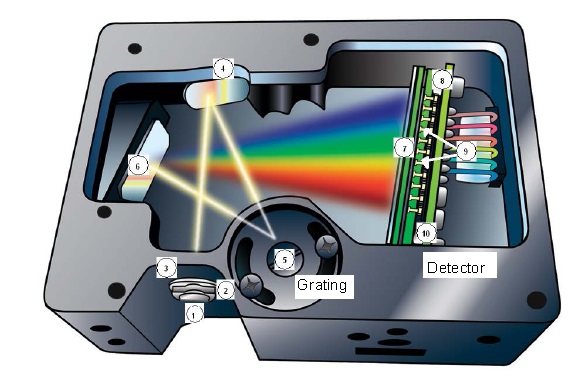
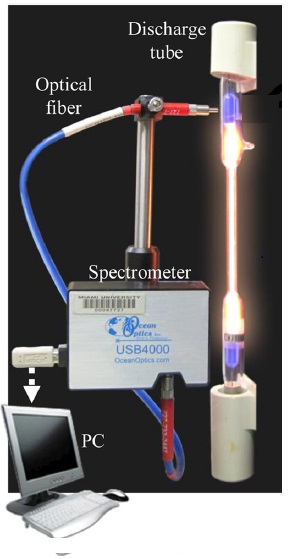
(Ocean Optics USB 4000, and USB Flame). The The whole integrated miniaturized contraption is pictured in figure 1.
Light from the discharge lamp is collected by a fiber optic cable and directed via mirrors to reflective grating, and from
there to the CCD detector, a quantum light detector that makes use of the photoelectric effect.
The detector is `calibrated' to readout intensity vs. wavelength. Before collecting the spectra, remember the following precautions:
The fiber optic cable can collect enough light to saturate the detector. Consult the instructor regarding the software controls that will permit desensitizing the detector. Information about this can be found in the OceanView manual (see lab course website).
The spectral lamps emits a considerable amount of
radiation in the ultraviolet region. This can cause severe
eye damage. Do not stare at the bulbs. Avoid
doing more than glancing at them otherwise. Turn them on only when acquiring a spectrum, then turn them off. This increases the lifetime of the tube.
The potential across the discharge tubes is about 5000
volts. Do not touch the discharge apparatus when the power
is on.
The lamps should not be kept on continually--only when taking data. Just after you turn them off, they will still be hot to the touch, avoid getting burned. Let them cool off before handling them.
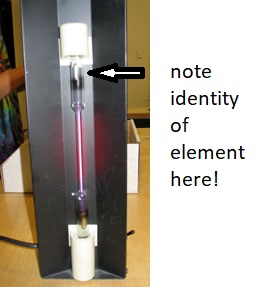
Record the name of the element by reading the label on the tube, not the label on the black discharge tube housing and power supply. Making sure that tube is not energized, and that the tube is cool enough, turn the label face forward if you need to read the label. In kindness to the next user, leave the tube face forward, and only after that, energize the tube to begin taking data.
Figure 1. On the left, a look into our modular spectrometer, showing its principal parts, and on the right, the basic setup with the plasma discharge lamp, fiber optics for light collection, and so forth.
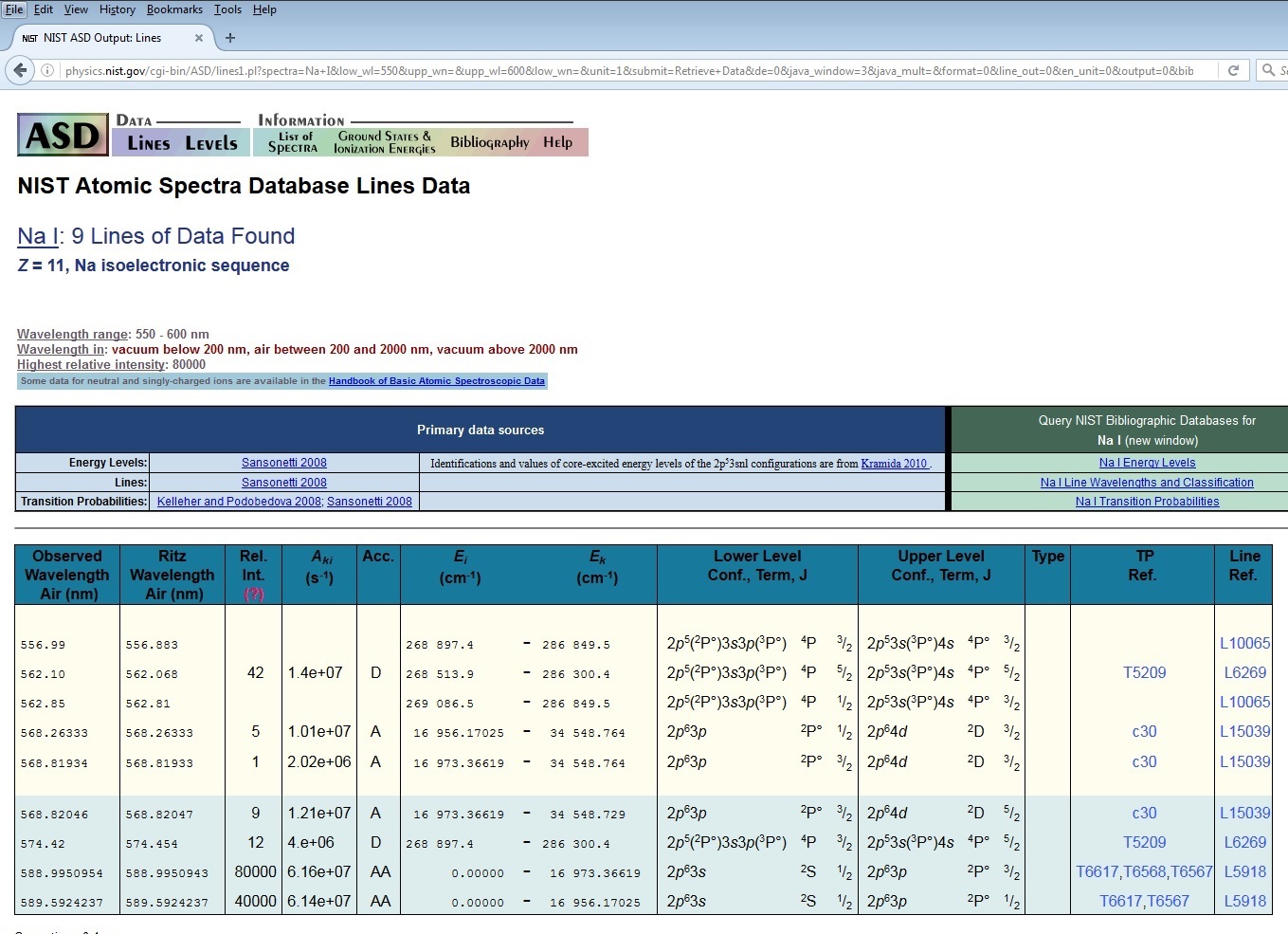
Make a table of at least 4 strong lines from the measured spectrum, including estimates of uncertainty. Sure, it's straightforward to identify the peak wavelength. What would you give as the experimental uncertainty of that determination? Explain in your lab notebook how you arrived at this estimate.Does the Ocean View manual give any hints at htis? Is there anything in your acquired data set that gives hints at this? Also, leave column headings for information to be found from the NIST atomic lines website (see below), described in task #2. Look up the NIST reference lines on their website (see figure below) for the elements you examined, find the lines you've measured and record the known values wavelength values. Include a column for discrepancy, keeping very good care to note whether the experimental value is low or high (keep track of the algebraic sign of the discrepancy). How can we can infer the goodness of the calibration, and the presence or absence of systematic uncertainties for the instrument? As with the lasers of a previous lab, should you keep using the same spectrometer? Explain. And in any case, before moving to a second source, make comparisons with the NIST lines for the element you are working with before moving on.
Figure 2. NIST atomic spectral lines output. Edit in the data for the lines you want on the landing page, noting for example, that Na I is the spectrum of the neutral sodium atom, Na II is that of singly ionized sodium, and so on.
5.3 Task #2: Compose energy level diagrams for each atomic spectra, showing the energy levels associated with the four strongest lines. How are the energy levels associated with spectral lines?
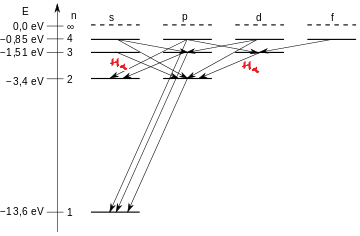
For each of the 4 spectra obtained, choose 4 spectral lines, and create a 'partial Grotrian diagram'[3,4], that indicates the relationship the individual spectral lines and the energy levels associated with them. Make sure your vertical scale has units, and that every horizontal line is in its correct elevation relative to the others, using 4 of the lines from task #1 to compose the partial Grotrian Diagram. Supplement the table prepared above with extra columns for the angular momentum states and energy levels involved. A Grotrian diagram is an energy level diagram (ELD) depicting transitions between energy levels as straight lines, which also separates levels according angular momentum, not just energy, and uses letters as separate column headings assigned to different values of orbital angular momentum, whether s, p, and d, and so forth for 0, 1, and 2 units of $\hbar$, and so forth. Nice examples of Grotrian diagrams of astrophysical interest may be found here.
Figure 3 below is an example of a partial Grotrian diagram for hydrogen with different emission lines indicated.
Figure 3. A sample partial Grotrian diagram for Hydrogen including some transitions in the Lyman, Balmer and Paschen series. Three different transitions deserve the name $H_{\alpha}$, and the slight differences in their wavelengths is known as `fine structure', and not resolvable (distinguishable) with our spectrum collecting apparatus. Do please annotate the ELDs you create for the 4 spectra you will collect, indicating the lines recorded in the tables for part I of these experiments.
The last thing to do of course is to compose an abstract as described in the 'notes on lab notebooks' page. You're going to ask, `how do we do discrepancies and uncertainties for the *diagrams*?' Well, hunt down a published partial-Grotrian diagram and compare it to yours! No, better, do that, then adjust yours, and *then* make the comparison!
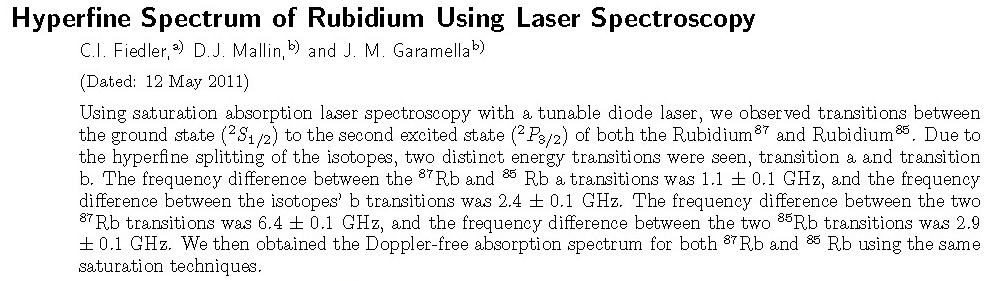
Perhaps a reminder is worthwhile to mention a nice summary of what is in an abstract. A picture, and then a list. Here's an abstract:
Figure 4. An abstract that achieves a fair amount of what is needed in an abstract. It is typeset using LaTeX, while the abstracts in our lab notebooks will generally be written in by hand (which is both fine and faster). This is the last thing you do before turning in your work.
Here's a list of what's in it:
a title for your lab report
a list of authors (you will be listed first, and your lab partners will be listed after that, in alphabetical order)
a statement of each of the research questions addressed in the lab,
a brief, broad, description (one-to-two sentences) of the methods used in lab,
the principal results, and a comparison with expected results, when appropriate
keeping in mind that there is just one abstract, it comes at the end of the notebook diary for a particular lab, and that it
is no longer than one page (but may be significantly shorter) and
should be read as prose ( i.e., not a bulleted list like this one:)
address the points listed above
is self-contained, ( i.e., does not assume the reader has read the lab instructions)
includes uncertainties and units, where appropriate. Results should be properly rounded: the uncertainty should be rounded to one significant figure, and the value should be rounded to the same precision as the uncertainty.
properly uses quantitative estimates of uncertainties and discrepancies to draw conclusions, when appropriate.
References:
P.A.M. Dirac, 'The Principles of Quantum Mechanics', 4th Ed. Oxford Science Publication, Oxford University Press, first published 1930 (I think he was 25) and the copyright has been renewed a bejillion times.
N. Bohr, the Trilogy: Part I-'On the Constitution of Atoms and Molecules', Part II-'Systems containing only a single nucleus', Part III-'Systems containing several nuclei', Philosophical Magazine, 26 1-25, 476-502, 857-875, (1913)
the original reference:
Graphische Darstellung der Spektren von
Atomen Ionen mit ein, zwei und drei Valenzelectronen.
Vol II. W.
Grotrian. Julius Springer, Berlin, 1928 Handbuch der Astrophysik.
Julius Springer, Berlin