Syllabus
| Description | Objectives | Grading | Academic Integrity | Text |
All commerce takes place in the broad context of the macro
economy; hence an understanding of factors that influence the
overall economy is essential for business managers. This course
is designed to provide an introduction to business economics,
including both micro and macroeconomic foundations. Topics to be
covered include: fundamentals of demand and supply, the forces
affecting the macro economy, monetary and fiscal policy, and
international considerations. Upon completion of the course,
students will be able to undertake supply and demand analysis to
their own firm or industry; identify and analyze international
trade conditions and opportunities; make accurate assessments of
the current state of the macro economy; and anticipate the
impacts of relevant policy initiatives by Congress and the
Federal Reserve System.
At the completion of this course, students will be able to:
-
perform supply and demand analysis to analyze the impact of
economic events on markets,
- compute different measures of macroeconomic activity, and
evaluate the
shortcomings of traditional economic measures,
- analyze the forces that affect the
aggregate level of economic activity and the business
cycle,
- recognize how monetary and fiscal policy can be used to
achieve policy goals,
- evaluate the determinants of international trade and
financial flows, and
- identify the social consequences of national and
international economic activity.
Grades in this class will be based on the examinations (60%) and
assignments (40%):
- There will be a quiz (worth 15% of your grade) and a
final (worth 45%). Each
exam will have problem, short answer, and essay questions.
Make-up exams will be given only if you have a
written excuse.
- Assignments include the following:
- Homework assignments (15%)
- Case analysis (10%)
- Team analysis of the macro economy of the United States
or another country
(15%)
Grades
will be assigned based on the total points earned during the
term, according to the following schedule:
| % |
Grade |
| 93 - 100 |
A |
| 90 -92 |
A- |
| 87 - 89 |
B+ |
| 83 - 86 |
B |
| 80 - 82 |
B- |
| 75 - 79 |
C+ |
| 70 - 74 |
C |
| 65 - 69 |
C- |
.
Ethical behavior is expected at all times.
From the Graduate Bulletin: "Academic
dishonesty is an affront to the integrity of
scholarship at USD an a threat to the quality of
learning. . . Violations of academic integrity
include: a) unauthorized assistance on an
examination; b) falsification or invention of
data; c) unauthorized collaboration on an
academic exercise; d) plagiarism; e)
misappropriation of research materials; f) any
unauthorized access to an instructor's files or
computer account; or g) any other serious
violation of academic integrity as established by
the instructor. An act of dishonesty can lead to
penalties in a course such as reduction of grade;
withdrawal from the course; a requirement that
all or part of a course be retaken; and a
requirement that additional work be undertaken in
connection with the course."
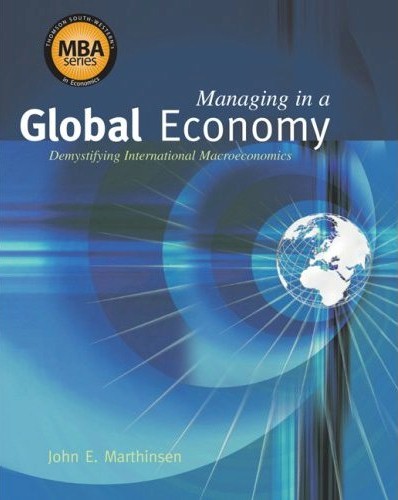
- John E. Marthinsen. Managing in a Global
Economy,
Thomson South-Western, 2008.
|
 |
|
